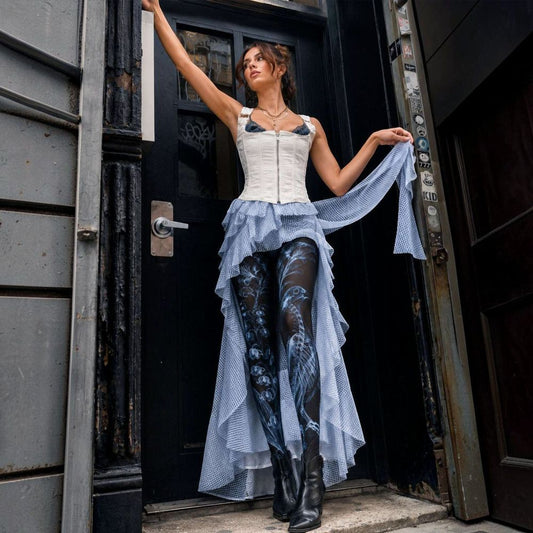
The Complete Guide to Tights: Types, Denier, Fit, Materials & Style
Tights may look simple, but choosing the right pair involves more than deciding between black and sheer.
Denier, transparency, material, stretch, fit, pattern, color, and occasion can all change how a pair of tights looks and feels. Add artistic prints and unconventional designs, and hosiery becomes not only a practical layer, but an important part of personal style.
Whether you are discovering tights for the first time or simply want to understand them better, this guide covers the essentials.
What Are Tights?
Tights are close-fitting legwear that typically cover the feet, legs, and lower torso in one continuous garment.
Depending on their construction, they can be:
- almost invisible and ultra-sheer
- semi-transparent
- opaque
- patterned
- textured
- colored
- footless
- decorative or artistic
Traditional tights were often treated as a background layer — something designed to complete an outfit without attracting much attention.
Modern hosiery can play a very different role.
Pattern, color, texture, and transparency can turn tights into one of the most expressive elements of an outfit.
Tights, Pantyhose and Stockings: Are They the Same?
The words are often used interchangeably, but there are some general differences.
Tights
“Tights” is widely used in the UK and Europe and can describe both sheer and opaque legwear.
Pantyhose
“Pantyhose” is more commonly used in the United States, particularly for thinner, sheer styles.
In modern fashion retail, however, the distinction is becoming less rigid.
Stockings
Stockings are separate pieces worn on each leg and usually extend to the thigh rather than covering the waist and hips.
For shoppers, the easiest way to think about it is:
Tights and pantyhose are generally one-piece garments. Stockings are separate leg pieces.
What Is Denier?
One of the most important terms in hosiery is denier, often shortened to “D.”
Denier is a measurement related to the thickness of the yarn used to create the fabric.
As a general rule:
Lower denier = thinner and more transparent
Higher denier = thicker and more opaque
Typical examples include:
5–10 Denier
Very sheer and lightweight.
Often chosen when you want the appearance of almost bare legs with a subtle finish.
15–20 Denier
Classic sheer hosiery.
Skin remains clearly visible through the fabric, but the tights provide more visual presence than ultra-sheer styles.
30–40 Denier
Often semi-sheer to semi-opaque.
These styles offer more coverage while still maintaining some transparency.
50–80 Denier
Usually considerably more opaque.
Colors and patterns can appear stronger because less skin shows through the fabric.
100 Denier and Above
Typically dense and opaque.
These are often associated with colder weather or outfits where maximum coverage is preferred.
These ranges are only a general guide. Yarn construction, knitting technique, color and material can affect the final appearance.
Two pairs of 30D tights do not necessarily look identical.
Sheer vs Opaque Tights
Denier and transparency are closely related, but shoppers often find it easier to think in visual terms.
Sheer Tights
Sheer tights allow the skin to remain clearly visible.
They tend to feel delicate and visually light.
Semi-Sheer Tights
These sit between sheer and opaque, giving more noticeable color and coverage without completely hiding the skin.
Opaque Tights
Opaque tights provide much greater coverage.
They can create a stronger visual block of color and work especially well with bold shades or graphic styling.
Neither option is inherently better.
The right choice depends on the effect you want.
Patterned and Art Tights
Patterned tights introduce another dimension: design.
Instead of simply changing the color or transparency of the legs, patterns can alter the visual balance of an entire outfit.
Common directions include:
- florals
- polka dots
- stripes
- geometric graphics
- abstract compositions
- animal-inspired patterns
- lace effects
- surreal artwork
- asymmetric designs
Art tights push this idea further by treating the leg as a moving canvas.
The pattern changes slightly as the fabric stretches around the body and moves with the wearer.
That makes fit especially important.
What Are Tights Made From?
Most modern tights use a combination of synthetic fibers engineered for softness, strength and elasticity.
Common materials include:
Polyamide / Nylon
Often forms the main structure of the tights.
It is lightweight and works well for fine knitted fabrics.
Elastane / Spandex
Provides stretch and helps the garment return toward its original shape after being worn.
Cotton
Sometimes used in specific areas such as the gusset for added comfort.
Different fiber blends create different results.
A greater percentage of stretch fiber does not automatically mean a product is “better.” The knitting structure, yarn quality and overall construction also matter.
How Should Tights Fit?
Good tights should feel secure without constantly reminding you that you are wearing them.
Look for a fit where:
- the waistband stays in place
- the crotch sits comfortably where intended
- fabric does not heavily bunch around the ankles
- the knees do not sag excessively
- the tights are not painfully restrictive
- the fabric does not need to be aggressively stretched to cover the legs
For patterned tights, correct sizing is even more important.
Excessive stretching can distort artwork, change spacing between design elements, and alter color density.
If you regularly experience sagging, rolling, excessive tension or distorted patterns, the size may not be right for you.
How to Choose a Tights Color
There is no universal rule saying tights need to match your shoes, skirt or dress.
Instead, think about the role you want them to play.
Neutral
Black, charcoal, brown and similar shades are easy foundations.
Tonal
Choose tights within the same color family as the rest of the outfit.
This creates a more continuous visual effect.
Contrast
Use tights to introduce a completely different color.
For example:
black outfit + red tights
navy outfit + yellow tights
cream outfit + blue patterned tights
Color Echo
Repeat one color from the tights somewhere else in the outfit.
It could appear in:
- a bag
- shoes
- jewelry
- a top
- a print
- an accessory
This can make even highly expressive tights feel intentional.
How to Style Patterned Tights
One of the easiest principles is:
Decide what you want the visual focus to be.
If your tights are highly detailed, the rest of the outfit can be relatively simple.
Try:
Simple outfit + expressive tights
For example:
- black mini dress + floral tights
- oversized blazer + graphic tights
- neutral skirt + colorful tights
- monochrome outfit + abstract hosiery
But you do not always need to keep everything else quiet.
Pattern mixing can also work when colors, scale or visual hierarchy connect the different elements.
Fashion does not need to be mathematically perfect.
It simply needs to feel intentional.
Choosing Tights by Occasion
Everyday
Comfort and versatility usually matter most.
Try moderate patterns, neutral colors or easy-to-style designs.
Work
The right choice depends heavily on workplace culture.
A conservative environment may favor subtle patterns, while creative workplaces can support much more expressive designs.
Evening
Sheer textures, darker patterns and stronger contrast can create a more dramatic effect.
Events
This is an opportunity to use tights as a statement piece rather than simply an accessory.
Personal Style
Sometimes there does not need to be an occasion at all.
You can wear a design simply because you like it.
How to Care for Tights
Delicate fibers and elastic structures benefit from gentle treatment.
For Avaeri art tights, we recommend:
- Hand wash cold at or below 30°C / 86°F
- Do not bleach
- Line dry in the shade
- Do not tumble dry
- Do not dry clean
- Avoid prolonged direct exposure to sunlight
Avoid aggressive wringing, rough surfaces, sharp jewelry and unnecessary heat.
Good care helps protect the fabric, elasticity, colors and artwork.
There Is No Single “Correct” Pair of Tights
Understanding denier, sizing and fabric gives you practical guidance.
But style remains personal.
Some people prefer almost invisible sheer tights.
Some want solid black opacity.
Others want flowers, color, graphics, asymmetry or something nobody expects.
That is what makes hosiery interesting.
A garment that once existed mainly in the background can become one of the most visible parts of an outfit.
The question is no longer simply:
“Which tights should I wear?”
It can also be:
“What do I want them to express?”