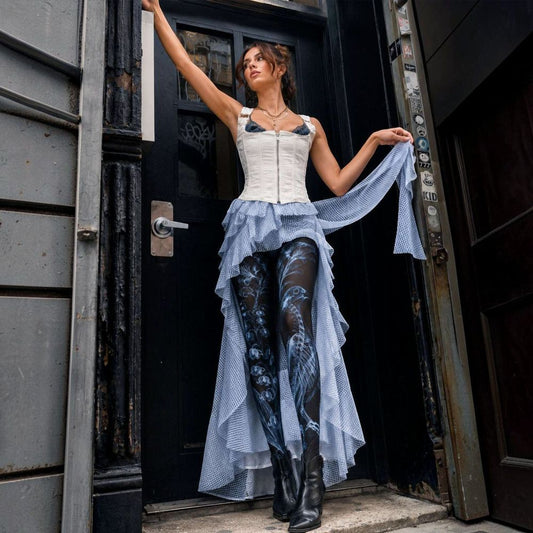
How to Choose the Right Tights: Denier, Size, Color & Occasion
The right tights are not necessarily the thickest, sheerest, darkest or most expensive pair.
They are the pair that works for your outfit, your body, your environment and the way you want to look.
That means choosing tights is easier when you stop searching for one universal “best” option and start answering a few practical questions.
This guide walks through them one by one.
Step 1: Decide What You Want the Tights to Do
Start with purpose.
Are you looking for:
- barely visible coverage?
- a stronger block of color?
- warmth?
- an artistic statement?
- something for work?
- something for an evening look?
- a pattern that transforms a simple outfit?
Your answer immediately narrows the options.
If appearance is the priority, focus on denier, color and pattern.
If comfort is the priority, fit and material become especially important.
If design is the priority, think about how the artwork interacts with the rest of the outfit.
Step 2: Choose the Right Denier
Denier gives you a useful indication of yarn thickness and usually relates closely to transparency.
5–10D
Choose this range when you want:
- an ultra-sheer effect
- minimal visual coverage
- a very lightweight appearance
15–20D
Good for:
- classic sheer looks
- dresses
- evening outfits
- warmer seasons
30–40D
Useful when you want:
- more visible color
- moderate coverage
- a balance between sheer and opaque
50–80D
Consider this range for:
- stronger colors
- cooler temperatures
- more noticeable coverage
- graphic patterns that benefit from a denser base
100D+
Best suited when you want a substantially opaque appearance.
Remember that denier is not a complete description of a pair of tights.
Color, knit structure and material also affect appearance.
Step 3: Decide How Much Skin You Want to Show
Sometimes it is easier to forget the number and simply ask:
How transparent do I want the tights to look?
Choose:
Sheer
when you want the skin to remain clearly visible.
Semi-sheer
when you want a balance of transparency and color.
Opaque
when you want significantly more coverage.
For art tights, transparency also affects the artwork.
A pattern over a sheer base can feel delicate and almost tattoo-like.
The same concept on an opaque base can feel much more graphic.
Step 4: Choose the Correct Size
Do not automatically choose your usual clothing size.
Tights sizing often considers a combination of:
- height
- weight
- hip measurement
- body proportions
Always check the size chart for the specific product.
What if you are between sizes?
If you fall between two sizes, consider:
- your height
- your hip measurement
- how much stretch you prefer
- the structure of the tights
Avoid deliberately sizing down simply because you want the tights to feel tighter.
Unless a product is specifically designed for compression, excessive tension can reduce comfort and distort the fabric.
For patterned tights, it can also change the artwork.
Step 5: Check the Fit After Putting Them On
Correctly fitting tights should generally:
- sit securely at the waist
- reach the crotch comfortably
- distribute fabric evenly along the legs
- avoid major bunching at the ankle
- avoid constantly sliding downward
- avoid painful pressure at the waistband
If you have to pull aggressively to reach the waist, the size may be too small.
If fabric repeatedly gathers around the knees or ankles, the size may be too large or the fit may not suit your proportions.
Step 6: Choose the Color
There are several useful strategies.
Choose a Neutral
Black remains popular because it works with an enormous range of clothing.
Other useful neutrals include:
- charcoal
- brown
- navy
- cream
- gray
Match the Outfit
Choose tights within the same general palette as your clothing.
This creates a more continuous silhouette.
Match the Shoes
Tights and shoes in similar colors can create a longer uninterrupted visual line.
Create Contrast
Colorful tights can intentionally break up a neutral outfit.
For example:
cream dress + cobalt tights
black outfit + red tights
gray tailoring + green tights
There is no reason your tights have to disappear.
Step 7: Decide Between Solid and Patterned Tights
Solid tights are useful when you want color or coverage without introducing additional artwork.
Patterned tights do something different.
They add:
- visual rhythm
- texture
- illustration
- personality
- contrast
Ask yourself:
Do I want the tights to support the outfit or become part of the statement?
If the answer is the second, patterned tights make sense.
Step 8: Choose a Pattern
Different patterns create different moods.
Floral
Can feel romantic, botanical, nostalgic or dramatic depending on scale and color.
Polka Dot
Often playful and relatively easy to integrate into an existing wardrobe.
Geometric
Feels more graphic, structured and contemporary.
Abstract
Allows more freedom and often works particularly well as wearable art.
Animal-Inspired
Can range from familiar fashion references to highly experimental interpretations.
Asymmetric
Creates a deliberately unconventional look because the two legs may not repeat the same visual composition.
There is no pattern that universally “suits” one kind of person.
Choose the visual language that interests you.
Step 9: Consider the Season
Spring
Sheer and semi-sheer styles can add pattern and color without visually weighing down an outfit.
Summer
Light hosiery can still work for evening, indoor environments or styling purposes.
Fall
This is one of the easiest seasons for tights because skirts, dresses, tailoring and boots naturally create layering opportunities.
Winter
Higher coverage generally becomes more practical.
The exact choice should depend on your local climate rather than the calendar.
Step 10: Consider the Occasion
Everyday
Prioritize comfort and compatibility with clothing you already own.
Work
Consider workplace expectations.
A subtle patterned tight may work easily in business-casual environments, while more artistic styles may suit creative workplaces.
Date or Evening
Sheer bases, darker designs and strong contrast can add visual interest without requiring a complicated outfit.
Party or Event
This is an ideal place for statement tights.
No Occasion
Also valid.
Clothing does not always require an event to justify being interesting.
Step 11: Consider Your Shoes
Before buying, imagine the tights with footwear you already own.
Think about:
- loafers
- boots
- Mary Janes
- heels
- sneakers
- ballet flats
A single pair of tights can feel dramatically different with different shoes.
This can make artistic tights more versatile than they initially appear.
A Simple Tights Decision Formula
If you are still unsure, use this:
1. Coverage
Sheer / Semi-Sheer / Opaque
↓
2. Fit
Check Size Chart
↓
3. Function
Everyday / Work / Evening / Statement
↓
4. Style
Neutral / Color / Pattern / Art
↓
5. Outfit
What will you actually wear them with?
That is usually enough to narrow down your choice.
The Best Tights Are the Ones You Want to Wear
Technical information matters.
Denier helps.
Size charts help.
Understanding materials helps.
But tights are still fashion.
There is no equation that can tell you whether you should choose black florals, bright geometric shapes or an asymmetric artwork.
Once fit and comfort are taken care of, the rest belongs to you.
Choose the pair that makes the outfit feel more like yours.